Most hay shed fires start inside the hay. Hay baled or stored too moist heats up as bacteria and fungi grow in it, and if the heating goes unchecked the hay can ignite by itself. CFA calls this spontaneous combustion the leading cause of haystack fires in Victoria, and says it attends around 150 haystack fires every year.
General information drawn from the fire services and NSW Department of Primary Industries. In an emergency, call Triple Zero (000).
Sheet
S-04
Subject
Hay storage
Covers
Vic, NSW guidance
Checked
8 Oct 2026
Governing sources
CFA: Hay fire prevention; NSW RFS: Haystack fires; NSW DPI Primefact 716, Hay shed fires (2009)
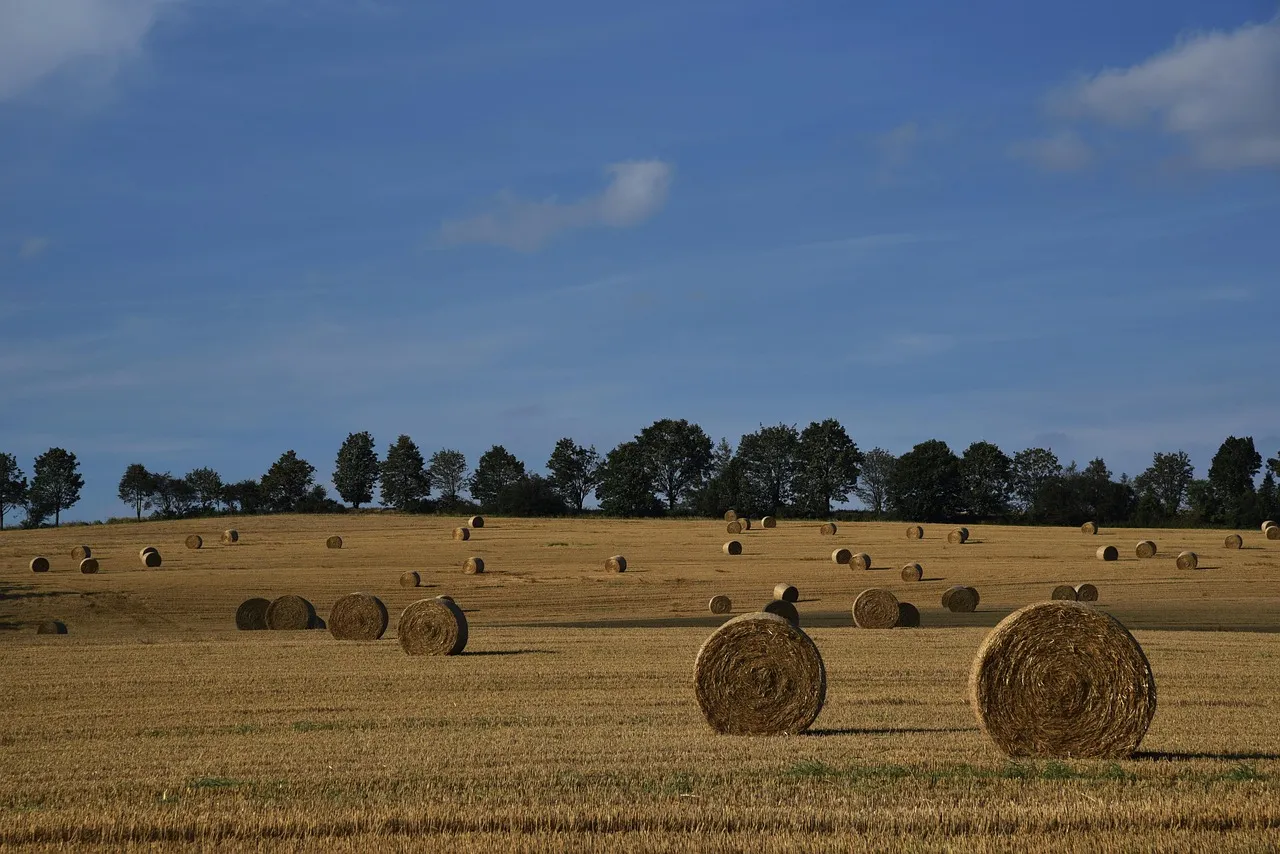
Round bales in a cut paddock. Photo by shargoo on Pixabay.
Why hay heats
CFA explains that hay cut too green, or damp when cut, encourages bacteria and fungi to grow and decompose it. A series of biological and chemical reactions then raises the temperature and can produce flammable gases, which ignite in the heat inside the hay. CFA says that once the temperature reaches 70°C it may rise rapidly to the point of spontaneous ignition, at about 180°C, and that a haystack fire can happen in any type of bale.
NSW Department of Primary Industries’ fact sheet on hay shed fires, which the NSW Rural Fire Service links from its own haystack page, lists what affects heating: moisture, air temperature, humidity, bale size, density, how the stack is arranged, and the type of crop, because crops high in sugars support more microbial growth. It notes that once bales are stacked in a shed, the advantage small bales have in losing heat is lost.
When it happens
CFA puts the window for combustion at anywhere from two weeks to three months or more after baling. The DPI fact sheet says heating may be noticed within days of baling wet hay, can occur over 2 to 10 weeks, and that reports of sheds heating 6 months after stacking are likely linked to a leaking shed.
Moisture at baling, as each source gives it
Source
What it says
CFA
Moisture content should be no more than 20%, with 12 to 18% recommended as a precaution. Use a correctly calibrated moisture meter, and test plant nodes and heads inside leaf sheaths for hidden moisture.
NSW DPI (2009)
As a general guide, hay above 16 to 18% moisture is at risk of heating or going mouldy; above 20% the risk increases; baled at 25 to 35%, spontaneous combustion is likely. For large bales, it advises bringing moisture down to 14 to 16%, and checking the recommended level for your baler with the machinery supplier.
The signs of heating hay
CFA lists these warning signs:
steam rising from the stack
condensation or corrosion under the hay shed roof
mould in or on bales
unusual smells: burning, musty, pipe tobacco or caramel
parts of the stack slumping
The DPI fact sheet adds that smoke means the problem is serious.
The crowbar check
CFA recommends a calibrated temperature probe, and notes that systems are available that monitor temperature in several places through a stack and send alerts to a phone. Without a probe, it describes the crowbar method: push a crowbar deep into the stack, leaving only the end out, leave it for two hours, then feel the end. Repeat in several places in a large stack. CFA’s warning applies while you check, too: “Don’t walk across hay that’s heating up”, because bales inside the stack can suddenly collapse and trap you.
You can hold it without discomfort
Under 50°C
Check the temperature daily.
You can hold it only for a short time
50 to 60°C
Check twice a day.
You can touch it only briefly
60 to 70°C
Pull the hay apart and move it to improve air flow. Check every two to four hours.
Too hot to touch
Above 70°C
There is potential for fire. Call Triple Zero (000) immediately. Do not pull the stack apart.
What the crowbar tells you, and what to do, as CFA sets it out. Read from the top down as the hay gets hotter.
CFA explains the last instruction: let air into a stack at 70°C or more and the hay can catch fire. It says to call Triple Zero (000) immediately if you see or smell smoke, or if any part of the stack is near 70°C or above it, or if you smell smoke or a caramel smell. And it warns against walking across hay that’s heating up, because bales inside the stack can suddenly collapse and trap you.
The DPI fact sheet, written in 2009, has its own temperature guide using a metal rod, and at 70°C it suggests considering safety precautions and moving the hay. CFA’s current page says not to pull a stack apart at 70°C or more. Where they differ, this sheet follows CFA’s page and shows the difference so you can ask your fire service.
Storing hay so one fire stays one fire
From CFA’s page:
Store hay in several locations and limit the size of each stack. CFA passes on the industry’s recommended limits for a single stack: $50,000 worth of hay, 400 large square bales or 250 tonnes.
Keep stacks 50 m apart, with a 20 m graded fire break around each one.
Keep a firefighting water supply near the hay; CFA recommends a 22,500 litre static supply.
Do not store vehicles, machinery or equipment with the hay, and do not store hay near fuel, kerosene or other chemicals or near powerlines.
Do not weld, grind or use heat or fire near hay.
Use ground moisture barriers under stacks and hay caps against rain, allow airflow around the stacks, and in a shed, leave space under the roof rather than stacking to the top.
The NSW Rural Fire Service gives the same core advice: store hay in several locations, keep machinery well away from it, and mow and maintain firebreaks around stored hay. The DPI fact sheet adds: keep flammable liquids, pesticides and fertilisers out of hay sheds, because “some fertilisers can explode or give off dangerous gases when exposed to intense heat”. Sheet 05 covers where those can go instead.
If the shed is a farm shed under the building code, it also carries portable fire extinguishers; Sheet 02 sets out the Part I3 rule.